Trade it in, or donate it?
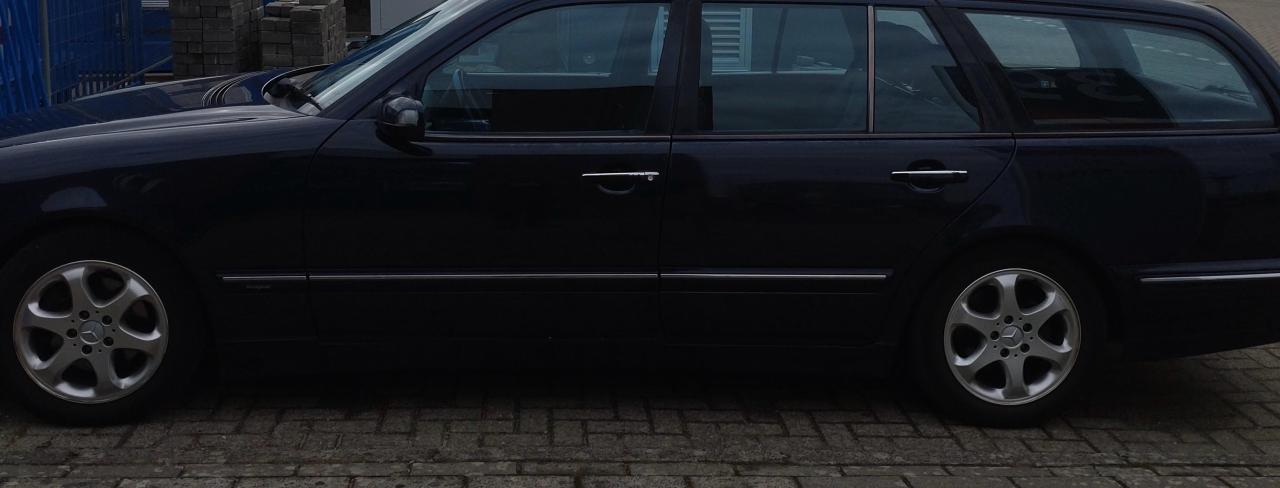
We will soon be driving another donated estate car to Ukraine. Over there it will be used for things like evacuations and hospital runs. The person who gave it away benefits too. Not only because it helps Ukraine, but financially as well. In this post we explain how that works, using a few examples.
A dealer's offer on your old car is usually disappointing, and selling it yourself is a hassle. Negotiating on a new car is also a good deal easier when there is no trade-in on the table. Have you ever considered simply giving your car away?
Stichting Aid to Ukraine has ANBI status, the Dutch designation for a recognised public benefit organisation. That means the value of a car you donate to us is deductible in your income tax return. Sometimes that comes to more than the dealer's offer, sometimes it does not. Below you will find how to work it out for your own situation, with 2026 figures. In quite a few cases it turns out in your favour.
What the tax authorities give back
Donating a car counts as a gift in kind, and the same rules apply as for a gift of money.
There is a threshold: only the part of your gifts above 1% of your threshold income counts, with a minimum of 60 euros. There is a ceiling as well, namely 10% of that same income.
The deduction falls under the rate adjustment for deductible items. As a result, your benefit in 2026 is at most 37.56% of the deductible amount, even if your income sits in the 49.5% bracket. If your entire income falls within the first bracket, up to 38,883 euros, the rate is 35.75%.
As a rule of thumb, then, you keep roughly a third of the market value.
Three examples
Say you earn 42,000 euros and your 2013 Golf is worth around 3,500 euros. The dealer offers 750, because the car is going straight on to the trade anyway. Your threshold is 1% of 42,000, so 420 euros. That leaves 3,080 euros to deduct, and you get 37.56% of it back: 1,157 euros. In this case donating earns you a good four hundred euros more than trading in, and you negotiate on a new car without the value of your old one depending on the price you pay for the new one.
Say you earn 95,000 euros and your car is worth 7,500. The threshold is now 950 euros, leaving 6,550 to deduct. Many people expect to get back close to half here, but it has not worked that way for some years now. It comes to 37.56%, so 2,460 euros. At the top rate it would have been 3,242. That eight-hundred-euro difference is the rate adjustment.
Whether donating works out better then depends on what the dealer is really offering. If you are offered 3,000 euros for the trade-in but could have negotiated a thousand euros more discount without it, giving the car to us is effectively worth two thousand. In that case donating wins.
Say you earn 38,000 euros and your van is worth 6,000. Here the ceiling bites. Only 3,800 of that 6,000 counts, because that is 10% of your income. After the threshold of 380 euros, 3,420 remains, and since your income falls in the first bracket the rate is 35.75%. You get 1,223 euros back, a fifth of the value. If the dealer makes you a reasonable offer, you are better off trading in. We would rather tell you that beforehand than afterwards.
| Example | Income | Market value | Deductible | Benefit |
|---|---|---|---|---|
| 1 | € 42,000 | € 3,500 | € 3,080 | € 1,157 |
| 2 | € 95,000 | € 7,500 | € 6,550 | € 2,460 |
| 3 | € 38,000 | € 6,000 | € 3,420 | € 1,223 |
With a tax partner
If you have a tax partner, you add your incomes and your gifts together, and that works in your favour.
Take a couple where one earns 55,000 and the other 25,000. That is 80,000 combined, so a threshold of 800 euros and a ceiling of 8,000. You donate a car worth 6,500 euros and 5,700 euros remains deductible.
Had the partner earning 25,000 donated that car on her own, the ceiling would have limited the deduction to 2,500 euros. So together makes a considerable difference.
You may then choose which of you claims the deduction, and that matters too:
| Claimed by | Rate | Benefit |
|---|---|---|
| The partner earning € 55,000 | 37.56% | € 2,141 |
| The partner earning € 25,000 | 35.75% | € 2,038 |
Claim it with whichever of you has an income above 38,883 euros, and make sure it stays above that line after the deduction as well.
When it is worth doing
Financially, donating wins as soon as the real trade-in offer drops below roughly a third of the market value. That sounds like a high bar, but it happens more often than you would think. Cars of twelve years and older, diesels a dealer would struggle to move on, an MOT due shortly or a repair waiting to happen, models the trade has little appetite for: in all of those cases the offer tends to be low.
It is also convenient. From the moment ownership is transferred, your road tax and your insurance stop. No adverts, no test drives with strangers, no phone call three weeks later about a noise when braking.
The threshold applies once a year across all your ordinary gifts combined, so it helps to donate the car in a year when you are giving to good causes anyway: those other gifts count towards the threshold too. And because your income drops, you may become entitled to a higher general tax credit or employed person's tax credit. Sometimes that pushes the real benefit above 37.56%.
Establishing the market value
The value that matters for a donation is the value in economic terms: what the car, in the condition it is in, would fetch when sold to a private buyer. So not the trade-in value, and not the asking price of a dealer who throws in a warranty.
If that value stays below 10,000 euros, no valuer needs to be involved and you may substantiate it yourself. There is no prescribed method. What matters is that your reasoning can be followed and that you keep the evidence.
In practice it works something like this. Search Marktplaats, AutoScout24, Gaspedaal or AutoTrack for roughly the same model, the same trim, the same year, the same fuel and transmission, with a mileage not too far off your own. Take five private adverts and use the median of those, not the highest. Then allow for the condition of your particular car: an MOT about to expire, damage, a timing belt coming due, a second key that has gone missing. Write down briefly how you arrived at your figure. Finally, put a price guide alongside it, from the ANWB for instance, as a second reference point.
Here is what that looks like in practice. For that 2013 Golf with 180,000 kilometres you find five private adverts: 3,700, 3,950, 4,100, 4,250 and 4,500 euros. The median is 4,100. The MOT expires in two months and there is a dent in the rear bumper, so you round down to 3,500. The price guide says 3,600. That is close enough.
Be careful with the sites that make you an instant offer on your car. They deliberately bid below market value, because they still have to resell it at a profit. An offer like that is a floor, not a market value.
Keep the evidence: the adverts as a PDF or a screenshot with the date visible, and your reasoning alongside. Do keep it somewhere. The tax authorities rarely ask, but if they do, those adverts will be long gone and there will be nothing left to reconstruct.
If the value is above 10,000 euros a year, or above 20,000 if you have a tax partner, the deduction is only allowed after an independent valuation, by a certified valuer for example. A recent purchase invoice is sometimes enough. Arrange that before you hand the car over to us, because a car already driving around Kharkiv is rather hard to have valued.
And in either case, be realistic. A value well above the market will not hold up, and in the end it costs you more trouble than money.
Donating through a business
Different rules apply there. The gift deduction in corporation tax was abolished as of 2025, and taking a car out of business assets counts as a withdrawal at market value, possibly with a taxable book profit. Sponsorship with a genuine business interest is sometimes the better route, since that is simply a business expense. Run it past your accountant and then give us a call, because company cars and vans are something we can put to excellent use.
Would you like to donate a car?
Send us an email with the details of your car. We will let you know whether we can use it, since not every car is suited to the journey or to the work out there. After that you establish the market value and we arrange the transfer. Keep your certificate of indemnity. From that moment your road tax and insurance stop.
If you would like one, we will give you a donation statement with the registration number, the date and our ANBI details. Keep that with your records. In your tax return you enter the amount under Deductible items, at Gifts.
A disclaimer, just to be safe: we are not tax advisers and this is not tax advice. The amounts and percentages above apply to 2026 and change every year. If you are in any doubt, ask your adviser or have a look at belastingdienst.nl.
Finally A car that fetches a few hundred euros from a dealer here is, in Ukraine, a car that collects people and delivers supplies.